
Why charging cables always break in the same spot
Contents4
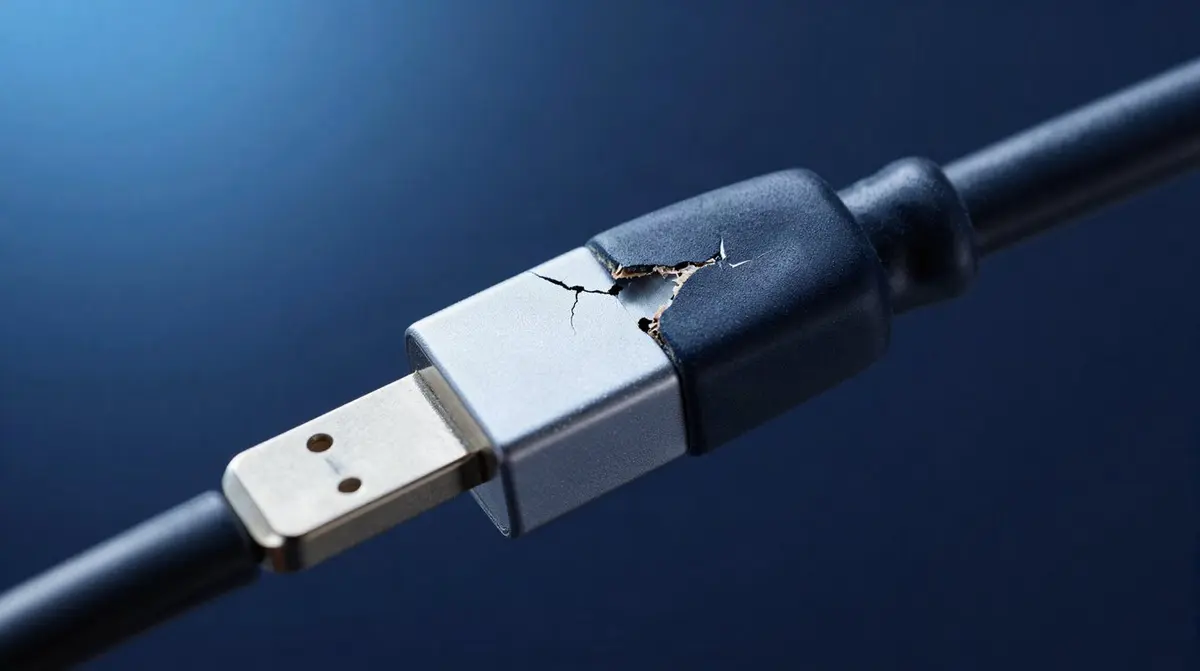
It is always the same spot. Not the middle, not the end at the power supply, but the two centimetres right behind the plug that sits in the phone. The jacket splits there first, then the fine strands show, and eventually it only charges when the cable lies just so.
The bend point is a question of leverage
The connector is rigid, the cable is flexible. The two meet at that transition, and every movement of the cable acts as a small lever exactly there. A cable bends along its whole length, but at that point always in the same tight radius. Copper strands take a lot, yet after a few thousand bends the outer ones break.
That also explains why the cables in bed and in the car die first. The phone sits at an angle, the cable leaves at a right angle and gets kinked again with every movement.
Four habits that make a real difference
- Pull the plug, never the cable. The single most common mistake, and the easiest to unlearn.
- Coil it loosely. A loop of roughly ten centimetres across, held with a velcro tie. Winding it tightly around the adapter is poison.
- Be generous with length. A two-metre cable lies relaxed, a one-metre one is pulled taut to the nightstand. Taut means permanently under tension.
- Right-angle plugs for bed and car. A connector bent through 90 degrees leads the cable off sideways instead of kinking it.
What the material does, and what it does not
Braided nylon protects against abrasion on a desk edge and against cat claws. Against bending it does little, because the break happens inside. What actually matters is the strain relief: the thickened rubber sleeve right behind the connector. The longer and more flexible it is, the more gently the bend is spread. Among our cables and chargers you can see it clearly in the product photos: a long, softly tapering sleeve is a better sign than any advertised tensile figure.
How to spot a dying cable
Charging cuts out briefly when you move the phone. The connector gets noticeably warm even at slow charging. The jacket feels harder in one place, or is split. Once the shielding is visible, the cable goes. Tape is not a repair: at that point a 60-watt cable carries 20 volts, and a crushed conductor can heat up.
Which kind of cable suits which job is covered in USB-C is not just USB-C.