
Outdoor Phone Case: How Much Protection Do You Really Need?
Contents6
An outdoor phone case promises protection from drops, dust and water, but not every activity needs the thickest armour. In this guide we explain what ratings like MIL-STD-810G and IP really mean, which four protection levels exist and how to match the right one to your day without turning your phone into a lump.
Protection ratings decoded: MIL-STD-810G, IP and drop-tested
Packaging is full of jargon. The three that matter most:
- MIL-STD-810G / 810H is a US military test standard. For cases the drop part (Method 516) counts: typically 26 drops from a defined height. Look for the stated drop height, usually 1.2 m to 2 m.
- “6ft / 1.8 m drop tested” is the concrete, honest number: the height the case survives. 1.8 m is roughly a drop from your hand while standing.
- IP rating describes sealing. First digit = dust (up to 6), second = water: IP67 means 30 minutes in 1 m of water, IP68 goes deeper and longer.
Note: many phones are already IP68 themselves. A case with an IP rating mainly protects the corners and screen on impact, not necessarily adding water resistance.
The four protection levels at a glance
Broadly, protective cases fall into four levels, from light to uncompromising:
1. Slim everyday case
Thin TPU or silicone, 1 to 2 mm, with a slightly raised screen lip. Guards against scratches and low drops. Ideal when looks and pocketability matter.
2. Reinforced-corner case
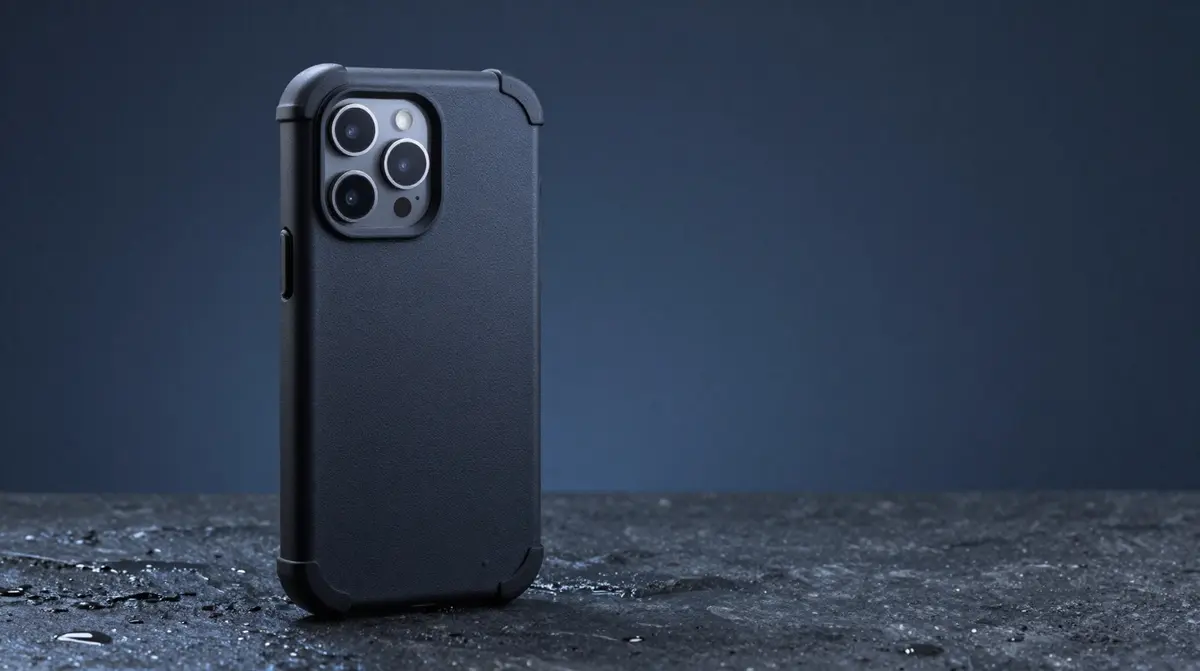
So-called air-cushion or bumper corners absorb impact energy exactly where phones land most. Usually tested to 1.8 m and still slim.
3. Rugged / armor case
Two-layer build of hard core and soft frame, often MIL-STD certified to 2 m, with a kickstand or belt clip. Noticeably thicker and heavier.
4. Waterproof case
Fully sealed housing with gasket and screen membrane, IP68. Protects while diving and in rain, but makes the phone bulky and muffles sound slightly.
Comparison: use case, protection level and features
| Use case | Recommended level | Typical features |
|---|---|---|
| Commuting, office, city | Slim or reinforced corners | 1.2 to 1.8 m, slim, good looks |
| Trades, work site | Rugged / armor | 2 m, dust-tight, belt clip, grippy |
| Hiking, ski, cycling | Reinforced corners to rugged | MIL-STD, cold-proof, mount-compatible |
| Water sports, boat, pool | Waterproof (IP68) or dry bag | Full seal, lanyard, touch through film |
Protection versus size: the honest trade-off
Every extra protection level costs volume and weight. A slim case often weighs under 30 g, a rugged case quickly double that and feels bulky. Ask yourself honestly: how far does your phone fall day to day, and how often? For most people the reinforced-corner level is enough, it covers the most common drops without wrecking your pocket. Only if you really head outside, into dust, wet or onto hard ground, do rugged or waterproof pay off.
Match it to your activity
Commuters: reinforced corners plus a phone chain against slipping out on the tram. Trades and work sites: rugged with a grippy surface and belt clip. Hiking and skiing: a MIL-STD case, cold-proof, easy to pair with an outdoor mount. Water sports: a waterproof case or a dry bag, so you can film on the board or boat without fearing for your phone.
Our pick: the RPD Rugged Defender
If you want a solid all-round solution, the RPD Rugged Defender is a strong choice: two-layer build, reinforced air-cushion corners, drop-tested to 2 m per MIL-STD-810G and still slim enough for daily use. All our cases ship from Swiss stock by A-Post, free from CHF 15 and with a 2-year warranty.