
Phones in Winter: Why the Battery Suddenly Collapses in the Cold
Contents5
On the piste, on a winter walk, on a platform: the phone still shows 60 per cent, you take a photo — and it shuts down. Back in a warm flat there are suddenly 45 per cent again. Not a fault, chemistry.
What happens in the cold
Inside a lithium-ion battery, ions move through a liquid electrolyte layer. The colder it gets, the more viscous that liquid becomes and the slower the ions travel. The battery can then no longer release its energy quickly enough.
The phone measures a voltage drop and reads it as «empty» — although charge is still there. It shuts down to prevent deep-discharge damage. Once the battery warms up, the reading comes back.
Does the battery take damage?
When discharging in the cold: no. That is a temporary effect which reverses completely on warming.
When charging in the cold: yes, and that is the important distinction. Charge a battery below roughly 5 °C and metallic lithium plates onto the anode instead of intercalating. That damage is permanent and accumulates. Modern phones therefore refuse to charge when very cold — a protective function, not a fault.
What helps in practice
- Carry it close to your body. Inside jacket pocket rather than an outer pocket or backpack. Body heat is usually enough.
- Do not carry it in your hand. Wind cools far faster than still cold.
- Let it warm up before charging. Bring a frozen phone to room temperature first, then plug in. Not onto a radiator.
- Flight mode in dead zones. A phone constantly hunting for signal in the mountains uses many times the power — and in the cold that costs double.
The power bank is the real answer
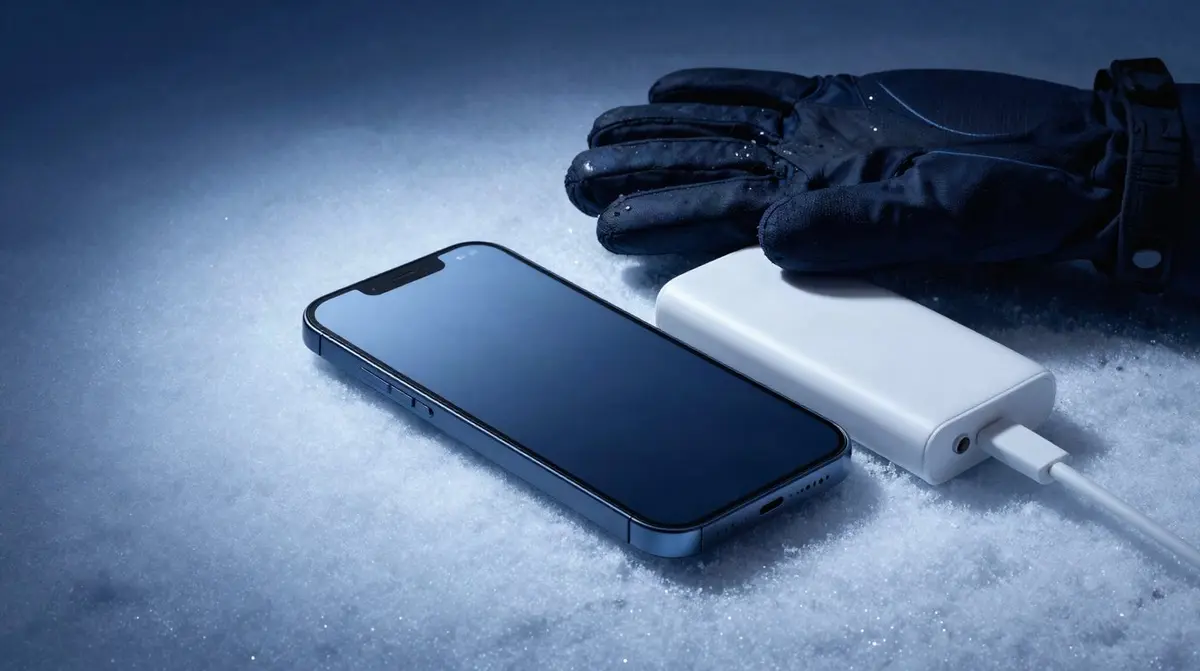
For a ski day, a winter hike or an autumn open-air, a power bank in an inside pocket beats any trick. It has the same cold problem, but it sits warm — and a warm reservoir can buffer a cold phone.
Two things matter: the power bank belongs against your body too, not in an outer backpack pocket. And it should be fully charged before you set out, because you will not top it up on the way. At Anker and UGREEN there are compact 10,000 mAh models that fit an inside jacket pocket — more capacity here mostly means more weight in the wrong place.
The case: insulation cuts both ways
A thick case insulates and keeps operating heat in the device longer — an advantage in winter. The same effect is the problem in summer, where it hinders heat dissipation. If you are outdoors a lot in winter, a slightly thicker case serves you better than a wafer-thin one.
| Situation | What to do |
|---|---|
| Phone shuts down at 40 % | warm it up, do not charge immediately — the reading returns |
| Photo below freezing | phone out of the inside pocket, shoot, back in |
| All day outdoors | power bank in the inside pocket, flight mode where there is no signal |
| After coming home | let it reach room temperature first, then plug in |