
When tempered glass and the case fight each other
Contents4
The glass is on cleanly, no bubble, no speck of dust. Two days later a corner lifts, then a bright line runs along the edge. Almost always this is neither the glass nor the fitting, but the fact that case and glass want the same millimetre.
The case lip pushes against the glass edge
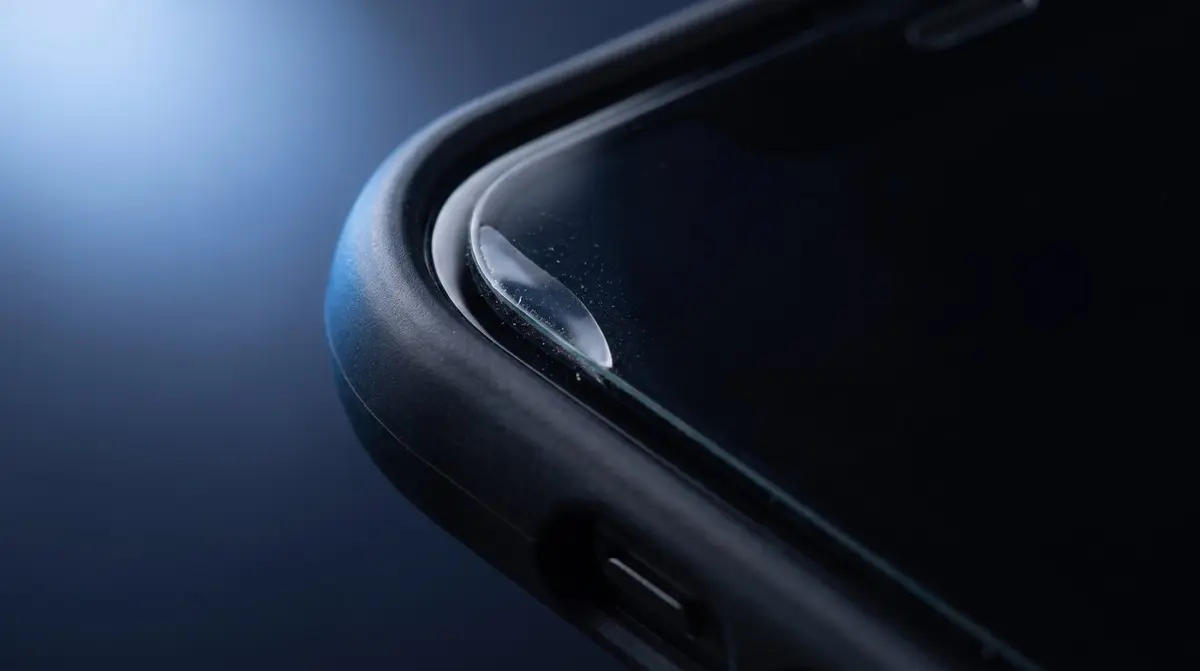
Good cases raise their lip one to two millimetres above the display so the phone does not rest on its screen. That is exactly where an edge-to-edge tempered glass ends. Fitting the case nudges the glass edge, the adhesive releases at that point, and from there the lifting works its way inwards.
Case-friendly means precisely that: the glass is cut one to two millimetres smaller all round and leaves the case room. You see a narrow bare margin, which no one notices in daily use.
Full adhesive rather than an edge bead
There are two constructions. With an edge bead, only a narrow outer strip is glued and the middle rests loose. Those are cheap, but show rainbow patches and release quickly under pressure from a case. With full adhesive, the whole surface bonds. It sits far more firmly, but forgives no correction while fitting.
| Full adhesive | Edge bead only | |
|---|---|---|
| Hold under a case | good | lifts at the corners |
| Appearance | no patches | rainbow effect possible |
| Fitting | one attempt | correctable |
| Fingerprint sensor | usually fine | more frequent misreads |
Curved displays are their own case
On models whose screen bends toward the sides, such as Samsung's Ultra variants, a flat glass will not bond at the edges. There you need either a flexible film that follows the curve, or a glass with UV adhesive that is bonded with a liquid. An ordinary tempered glass on such a screen lifts within days.
The order that works
Fit the glass first, then use the phone for about a day without a case so the adhesive fully cures. Then put the case on and check whether the lip rests on the glass edge anywhere. If it does, a case-friendly cut is the right answer, not more pressure.
The step-by-step fitting is in applying and removing tempered glass, and the glasses themselves are in screen and camera protection.