
Swollen power bank: how to dispose of it safely
Contents6
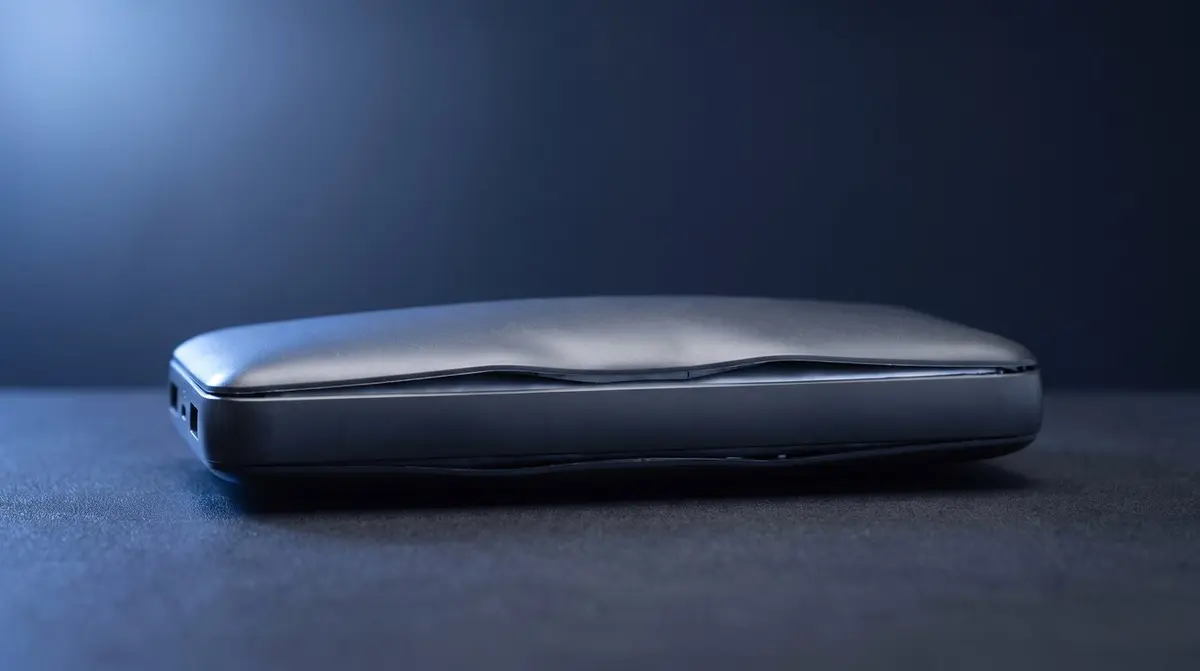
If your power bank is swollen, meaning the casing bulges or no longer sits flat, this is not a cosmetic flaw but a serious safety signal. The lithium-ion battery inside is producing gas because it is damaged. First things first: stop charging it, stop using it, never pierce it and dispose of it properly. In this guide we explain calmly and concretely why this happens and what you should do step by step.
Why a lithium battery swells
Every power bank contains lithium-ion or lithium-polymer cells. When the battery swells, gases form inside, an effect experts call outgassing. The most common causes:
- Age and charge cycles: After 500 to 1000 full cycles the cell chemistry ages. The electrolyte breaks down and gas forms.
- Heat: A car in the summer sun quickly reaches 60 to 70 degrees. That massively accelerates chemical breakdown.
- Deep discharge: Leaving a power bank empty for months risks a harmful deep discharge of the cell.
- Physical damage: A drop, pressure in a backpack or a punctured cell all lead to swelling.
- Cheap cells and overcharging: Without good protection electronics, the cell gets overcharged and damaged.
Why a swollen power bank is dangerous
The gas that forms is under pressure. In the worst case it triggers thermal runaway, a chain reaction in which the cell keeps heating itself until it catches fire or bursts. Such a battery fire is very hard to put out with water and releases toxic fumes. That is why a swollen power bank counts as hazardous material that you should treat with respect, but without panic.
Warning signs and the right response
Not every symptom means immediate fire, but each deserves to be taken seriously. This table helps you react correctly:
| Warning sign | What it means | The right response |
|---|---|---|
| Casing bulges slightly, wobbles on the table | Cell is outgassing, early defect | Stop charging or using it, store cool and fireproof, dispose of it |
| Clear bulge, split casing | Advanced damage, high risk | Do not move it while hot, take it to a safe spot, dispose of it quickly |
| Power bank gets hot, smells sweet or chemical | Possible thermal runaway | Keep your distance, place on non-flammable surface, call fire service 118 if needed |
| Smoke or hissing | Acute fire risk | Leave the room, call 118, do not use water |
How to dispose of the power bank in Switzerland
A power bank never belongs in household waste, nor in normal scrap metal collection. In Switzerland take-back is mandatory: every retailer that sells batteries must take them back free of charge, even without a new purchase.
- Point of sale: Hand the power bank in at the counter of any electronics or retail shop that stocks batteries.
- Collection point: Municipal collection points and recycling yards accept electronics and batteries.
- Battery collection box: Smaller power banks often fit into the green INOBAT collection boxes found in retail stores.
For transport, tape over the contacts and the USB port with insulating tape, and for a strong bulge place the device in a fireproof container such as a metal box with some sand. In the meantime you can find safe replacement units in our power banks category and matching batteries.
How to prevent swelling
A few habits keep your power bank safe for years longer:
- Avoid heat: Never leave it in a car in summer or in direct sun. Ideal is 10 to 25 degrees.
- Do not fully drain: Recharge before it is completely empty. For storage, a charge level of around 50 to 60 percent is ideal.
- Buy quality: Models with good protection electronics, overcharge and short-circuit protection last much longer.
- Use it regularly: A device charged every few months ages more slowly than one left idle for years.
- Right cables: Use intact, certified cables and chargers.
When to replace a power bank
As a rule of thumb: if the power bank noticeably loses capacity, so it only delivers a fraction of the charges, or shows the first signs of a bulge, it is time for a replacement. After a hard drop or if it gets unusually hot while charging, retire it too. A new unit often costs only a few francs more than the risk is worth. Order from us and the replacement ships from our Swiss warehouse, free by A-Post from CHF 15 and with a 2-year warranty.