
Car phone mounts: magnet, clamp or air vent?
Contents7
In the car, your phone is your sat nav, music player and hands-free kit in one – but only if it is mounted securely. If it slides around on the passenger seat or sits in the cup holder, every glance at the screen becomes a risk and can quickly get expensive in Switzerland. In this guide we compare the five most common mount types, explain the legal situation and show you which mount suits your driving profile.
What Swiss law says
Under Art. 3 para. 1 of the Swiss Traffic Regulations Ordinance (VRV), you must keep your attention on the road and traffic and must not do anything while driving that makes operating the vehicle harder. In practice this means: phoning without a hands-free system costs a fixed-penalty fine of CHF 100. If you hold and operate the phone while driving, you also risk being reported to the authorities, with a much higher fine – up to losing your licence.
A mount solves the problem, but only if it is installed correctly: it must not restrict your field of vision. If your phone is stuck in the middle of the windscreen, you risk fines of several hundred francs. More on this in the mounting tips below.
The five mount types at a glance
MagSafe and magnetic mounts
Magnetic mounts are currently the most popular solution: hold the phone up, click, done. You dock with one hand and take the device with you just as quickly. iPhones from the iPhone 12 onwards have the MagSafe magnets built in; Android devices can be retrofitted with a magnetic case or an adhesive ring. What matters is sufficiently strong magnets so the phone stays put even on bumpy roads.
Clamp mounts
The classic with spring-loaded arms that grip the phone from the sides. It works with any smartphone and any case and holds even large, heavy devices rock solid. The downside: you usually need both hands to insert the phone, and the clamp arms can cover the side buttons.
Air vent mounts
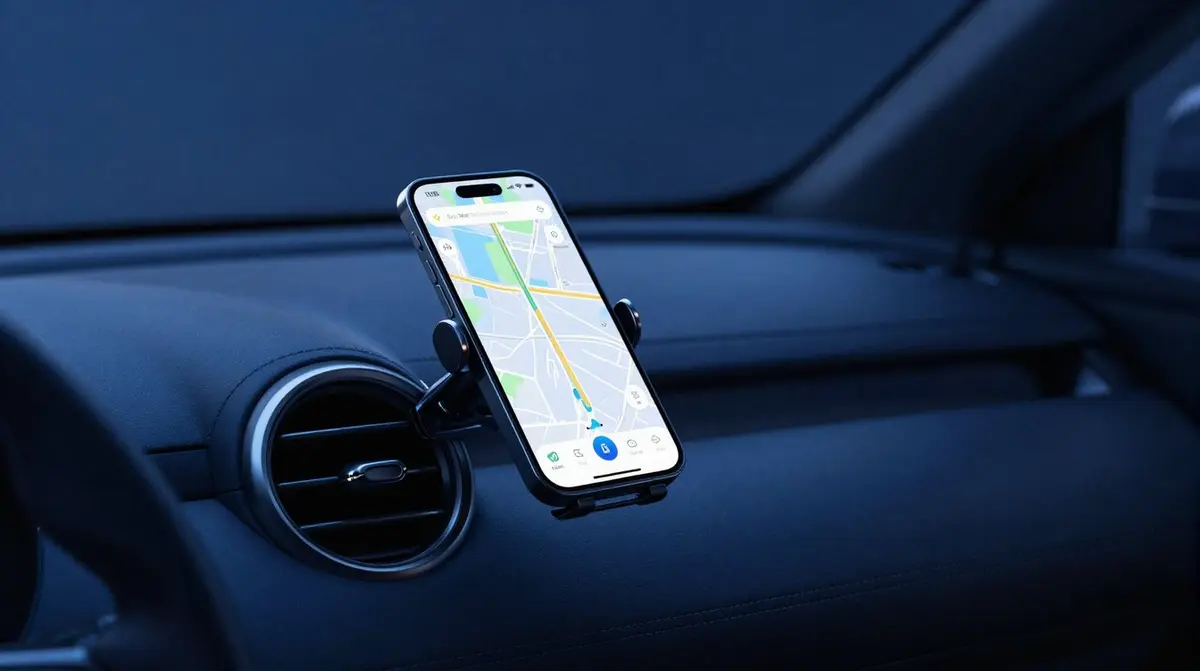
These mounts simply clip into the vent slats – no gluing, no drilling. The phone sits low enough not to block your view. The drawbacks: the slats carry all the weight, in winter the heating blows straight at the device, and many modern EVs no longer have classic vent slats at all.
Suction cup mounts (windscreen or dashboard)
Suction cup mounts with a gel pad stick to the windscreen or dashboard. They carry any weight, can be positioned flexibly and do not block any vents. In return, you have to choose the position with your field of vision in mind, and the suction cup needs a little care so it does not drop off in heat or cold.
Qi charging mounts: holding and charging in one
Qi charging mounts combine a mount with a wireless charger: your phone charges while you navigate. The latest generation with the Qi2 standard charges magnetically at up to 15 watts – enough to fill the battery even while navigation is running. They come as a magnetic version and as a motorised clamp version; all you need is a free USB or cigarette-lighter socket.
Comparison: pros and cons at a glance
| Type | Hold | One-handed use | View | Summer heat | EV |
|---|---|---|---|---|---|
| MagSafe/magnet | very good (with strong magnets) | yes, dock with one hand | freely positionable | uncritical | good (with adhesive or suction base) |
| Clamp | very good | no, usually two hands | depends on position | uncritical | good |
| Air vent | good | yes | stays clear | A/C cools the phone | often unsuitable (no slats) |
| Suction cup | very good | partly | mind the field of vision | grip may weaken | good |
| Qi charging mount | very good | yes (magnetic version) | freely positionable | phone gets warm while charging | good |
MagSafe in the car: iPhone directly, Android with a magnetic case
MagSafe has evolved from an iPhone feature into a de facto standard. All iPhones from the iPhone 12 onwards dock directly onto any MagSafe-compatible mount. On Android it looks like this: the newest Samsung Galaxy models partly support the magnetic Qi2 standard out of the box; for most other devices you simply retrofit the magnetic ring – either with a suitable magnetic case or a thin adhesive ring for the back. Make sure both case and mount are labelled as «MagSafe-compatible» or «Qi2» – then the magnet position is right for a secure hold and wireless charging.
Installation: 5 tips for a secure hold
- Keep your view clear: mount the holder low in the middle of the dashboard or at the left edge of the windscreen – never in the middle of the windscreen.
- Avoid airbag zones: do not mount above the steering-wheel airbag or airbag deployment covers, otherwise the mount becomes a projectile in a crash.
- Clean the surface: wipe the windscreen or dashboard with a little alcohol before mounting and let adhesive pads cure for 24 hours.
- Care for the suction cup: rinse the gel pad occasionally with lukewarm water and let it dry – this restores the grip. In a parked car in intense summer heat, better take the mount down.
- Route the cable neatly: run the charging cable so it does not hang in front of the gear lever or controls.
Our recommendation by user type
- Commuters: a MagSafe magnetic mount for the air vent or dashboard – no other type is as fast for daily docking and undocking.
- Frequent drivers using navigation: a Qi2 charging mount with a suction or adhesive base. The phone stays charged and you can position it perfectly in your line of sight.
- EV drivers: an adhesive or suction base on the dashboard instead of the vent – many EVs have hidden air outlets without classic slats.
- Family and shared cars: a clamp or suction cup mount, because it works with every device and every case.
Conclusion
For most people, a magnetic mount is the best choice today: one-handed operation, flexible mounting and – thanks to MagSafe and Qi2 – easy to combine with wireless charging. If you navigate for hours every day, go for a Qi2 charging mount; if you need maximum compatibility, a clamp still serves you well. You will find suitable mounts and charging accessories for your car in our car accessories range – mostly for CHF 15 to 50, with a 30-day return window and a 2-year warranty.