
Which port does your device have?
Contents6
You want to buy a new charging cable or charger but are not sure which plug fits? You are not alone: USB-C, Lightning and Micro-USB look similar at first glance, but they are not compatible. This guide shows you in a few seconds which port your smartphone, tablet or accessory uses – so you know exactly which cable you need.
The three most important connectors at a glance
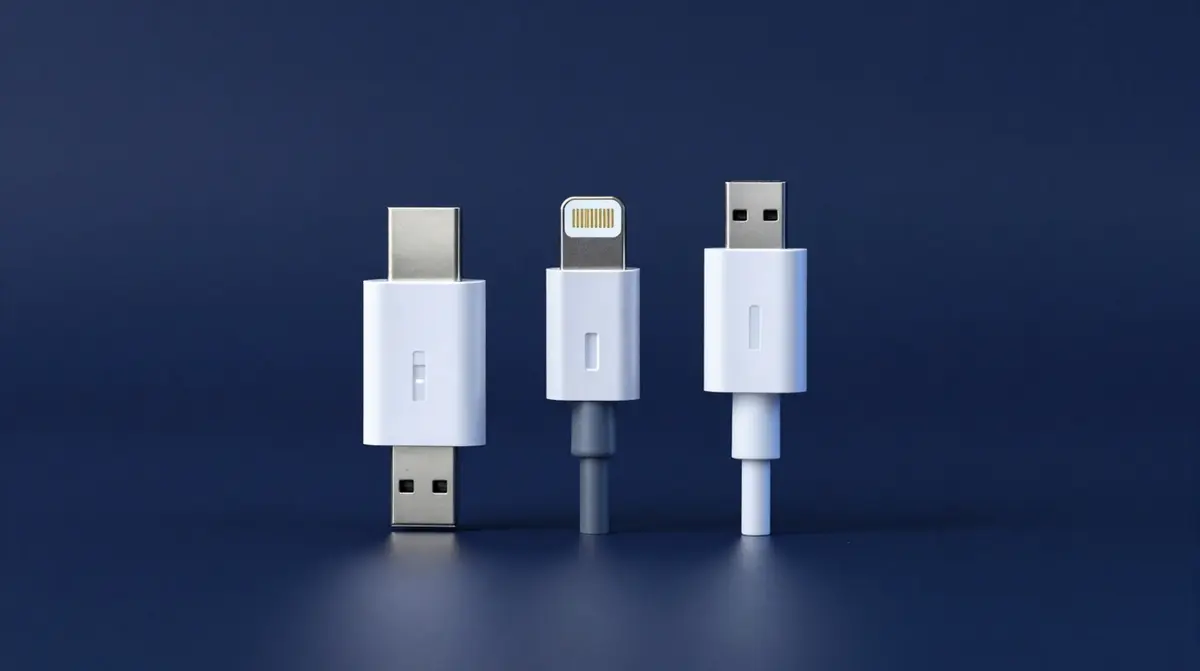
USB-C is the current standard: an oval, symmetrical port where the plug fits either way up. Practically all new smartphones, tablets and notebooks use it.
Lightning is the slim Apple plug with openly visible contacts. It is found in older iPhones, many iPads and older AirPods charging cases. Lightning is also reversible.
Micro-USB is recognisable by its trapezoid-shaped port that only fits one way. It is found in older Android phones and is still common on budget accessories such as lamps, speakers or older power banks.
How to identify the port at a glance
| Feature | USB-C | Lightning | Micro-USB |
|---|---|---|---|
| Shape | Oval, symmetrical | Slim, flat, visible contacts | Trapezoid, one side narrower |
| Reversible | Yes | Yes | No |
| Typical devices | New smartphones, tablets, notebooks | iPhone 5 to iPhone 14, older iPads & AirPods | Older Android phones, budget accessories |
| Era | From ca. 2016, standard today | 2012 to 2023 (Apple) | Ca. 2008 to 2017 |
Which port does your iPhone have?
With Apple the dividing line is clear: from the iPhone 5 up to the iPhone 14 (including all SE models) Apple used the Lightning port. From the iPhone 15 (2023) every iPhone charges via USB-C. Not sure which iPhone you own? Our device identifier helps you find out.
The AirPods case is worth a look too: older cases charge via Lightning, while the AirPods Pro 2 (USB-C version) and the 4th generation charge via USB-C.
Samsung, Google & other Android devices
Samsung has used USB-C consistently since the Galaxy S8 (2017); in the more affordable A series, Micro-USB survived until around 2019. Google Pixel has used USB-C since the very first model (2016). As a rule of thumb: an Android phone built from 2018 onwards almost certainly has USB-C, while older or very cheap devices often still use Micro-USB.
iPads and tablets
The iPad switched to USB-C step by step: iPad Pro from 2018, iPad Air from the 4th generation (2020), iPad mini from the 6th generation (2021) and the standard iPad from the 10th generation (2022). All older iPads charge via Lightning. Android tablets follow the same rule as the phones: newer models USB-C, older ones Micro-USB.
Choosing the right cable and charger
Once you know the port, the rest is easy:
- USB-C device + modern charger: A USB-C to USB-C cable is the best choice and enables fast charging.
- Lightning iPhone + modern charger: With a Lightning to USB-C cable you charge much faster than with the old USB-A cable.
- Lightning iPhone + older charger: The classic Lightning to USB-A cable fits here.
- Micro-USB device: Micro-USB to USB-A cables are still available, including as replacements for lost originals.
By the way: since the end of 2024 the EU requires USB-C as the standard port for new smartphones, and in Switzerland too practically only USB-C devices reach the market. If you invest in USB-C cables and chargers today, you are set for the long run. And if you want to skip the plug question entirely, wireless and MagSafe chargers are a convenient alternative.